
I've been having this conversation with practice owns more and more, and there's a lot of confusion about what AI visibility actually means. Most people assume that if they have decent SEO, they're covered.
Here's what I'm seeing firsthand: patients are increasingly using ChatGPT, Claude, and Perplexity to find dentists instead of going straight to Google. The problem? These AI assistants aren't just pulling from your Google ranking. They're looking for something completely different.
I was just on a call last week with a dentist in Scottsdale who has a beautiful website, ranks well on Google Maps, and has great reviews. He asked ChatGPT to recommend a dentist in his area who does sedation dentistry and accepts specific insurance. ChatGPT recommended three practices. He wasn't one of them.
Why Traditional SEO Doesn't Equal AI Visibility
Traditional SEO is built around keywords and short phrases. You optimize for "dentist in Austin" or "root canal specialist," and Google either ranks you or it doesn't. It's a fight for 3-5 spots at the top, and everyone else is basically invisible.
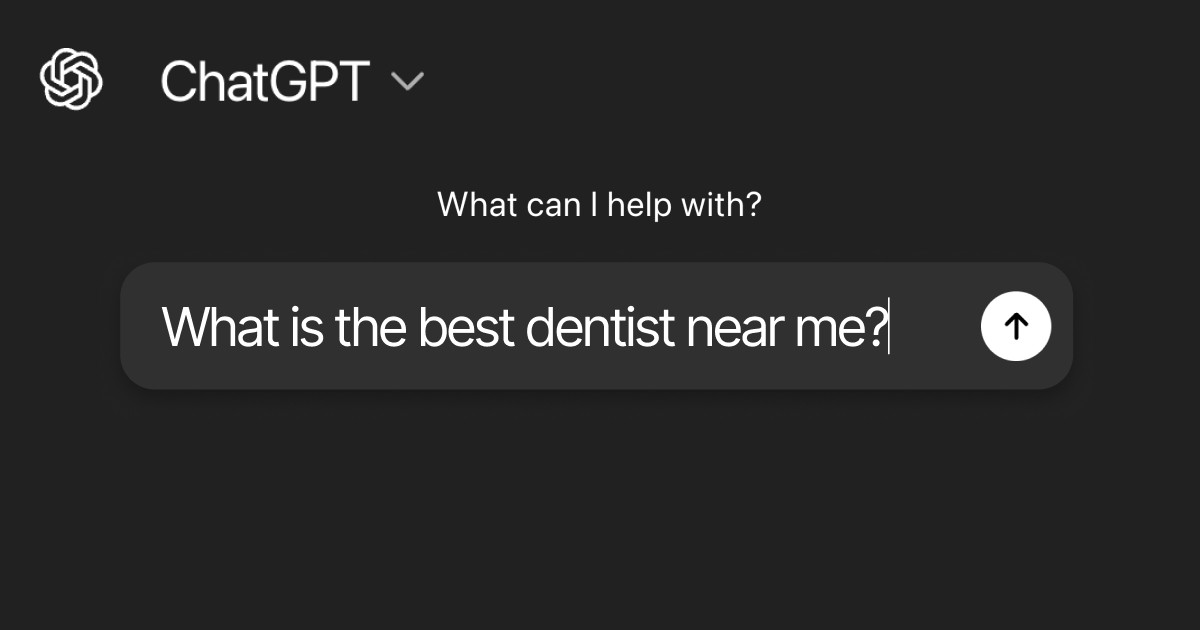
AI search works fundamentally differently. When someone uses ChatGPT, they're not typing "dentist near me." They're having a conversation. They're asking things like:
"I need a dentist in Miami who can handle root canals with sedation options, accepts Premera insurance, and has availability this week."
For AI to recommend your practice, it needs to find all of those data points on your website. Not just that the information exists somewhere, but that it's structured in a way AI can actually parse and understand.
The Information Gap Most Practices Have
I see the same pattern over and over: practices have the information patients want, but it's buried, unstructured, or simply not there at all.
Let's use that Miami example. For ChatGPT to recommend you, it needs to clearly find:
You're a dentist
Located in Miami
You perform root canals (probably on your site)
You offer sedation options (maybe mentioned?)
You accept Premera insurance (probably not listed specifically)
You typically have availability within a week (definitely not on your site)
Most dental websites fail at #5 and #6. Truth is, patients often chat with AI multiple times before asking for a recommendation, giving it tons of context about their specific situation. If your website doesn't have that level of detail, you're just not in the running.
The Generic Content Problem
Lately I've been seeing more and more dental websites with obvious ChatGPT-written filler text. You know the kind; generic, full of emojis and the "it's not x – it's y" format.
Here's what most practices don't realize: search algorithms are now smart enough to detect this stuff and penalize you for it. AI-generated content isn't inherently bad for search visibility, but low-quality filler AI slop actually hurts your visibility because it signals low-value content. Your competition is shooting themselves in the foot with this, which is great news for you if you do it right.
How to Actually Get Visible to AI
The fix isn't complicated, but it does require a different approach than traditional SEO.
Start with your homepage: Keep it clean and human-focused. This is for actual people visiting your site, not for AI. Emphasize trust signals and ease of access; all the emotional factors that make someone want to book. Skip the wall of text about your 20-year history. That's not what converts patients.
Create dedicated procedure pages: This is where you go all-in on information. Each service you offer – veneers, root canals, implants, whatever; should have its own page loaded with specific, detailed content. These pages are primarily for AI to crawl, though they're still totally usable for humans who land there.
If done correctly, when someone asks ChatGPT about veneers, they'll end up directly on your veneers page. And here's the beautiful part: ChatGPT will have already answered their questions about you before they even click through. At that point, it's just up to your site to have a clear way for them to contact you.
Content Formatting That AI Actually Reads
AI loves certain formats. Here's what's known to work:
Question and answer format (FAQs): AI loves this because questions on your page often match what people are asking ChatGPT. The more specific and insightful your answers, the better.
Tables: Excel-style tables are incredibly easy for AI to parse. Use them for pricing tiers, insurance coverage, procedure comparisons. Anything with structured data.
Schema markup: This is hidden code that explicitly tells AI what's on your page so it doesn't have to parse as hard.
Site speed: AI sometimes won't fully search slow, bloated websites because they blow through computing power budgets set by the AI companies.
The Content Creation Shortcut I Use
I use OpenAI Deep Research to gather real quotes from real people across 700+ online sources, including places like r/AskDentists on Reddit. This takes about 20-30 minutes per research query and gives me a massive list of actual questions patients are asking before, say, getting dental implants.
From there, I turn those into a clean question list and send it to the dentist. Instead of making them write for hours, I have them record a voice message or answer the questions over a recorded call. Then I use AI to clean up the transcript while keeping their natural voice, and inject the keywords and phrases that trigger AI recommendations.
The result? Authentic, specific content that actually addresses what patients want to know, written in the dentist's own voice, without eating up their entire week.
Why This Matters More Than You Think
Practices that are thinking about AI have first-mover's advantage. Most dentists haven't even though about AI visibility.
Meanwhile, patients, especially younger demographics, are increasingly comfortable asking AI for recommendations. When they do, they're not seeing your practice. They're seeing whoever figured this out first.
And here's the thing about AI recommendations: there's no limit to how many practices can be recommended. Google has 3-5 spots at the top. ChatGPT doesn't work that way. It'll recommend whoever genuinely matches the query, which means there's no artificial scarcity. If you have the right information structured the right way, you're in the conversation.
Final Thoughts
The evolution is pretty straightforward when you look at it: physical sign → Yellow Pages → website → Google → AI. We're at that AI transition point right now, and most of the industry hasn't caught on yet.
Optimizing for Google absolutely isn't a bad idea, and many current SEO tactics benefit AI search too, but the practices that move early on this will dominate their markets. I can't possibly cover every nuance in an article like this, but hopefully this gives you a clearer picture of what's actually happening and what you can do about it. The window for first-mover advantage is still open, but it won't stay that way forever.

We'll talk about your current setup, what is and isn't working, and walk you through your free landing page which will be completed prior to our meeting!